The farther backward you can look, the farther forward you can see
I’m not yet 30. I was shitting my nappy during the dot-com bubble and trading Pokémon cards during the GFC. My personal experience of the world, markets, and political dynamics is limited by the mere lifespan of a rabbit.
Yet, even in that brief period, I have noticed shifts in every factor that influences my life and the society around me. Financial instability, political polarisation, widening wealth divides, rising House Prices, currency debasement, and the ever-present rampage of money printing. There is a storm brewing, and you don’t need fifty years of experience to feel the pressure starting to pop.
Still, that observation does not provide me with much. Maybe I have an inkling of insight to sense the world getting shitter, but I clearly don’t have the experience to understand what that means, or more importantly, use that insight to predict where we could be heading and position myself accordingly.
With little personal wisdom to pull from, I must look to history, books, and others with far more knowledge than I. Not because the past gives answers, but because, just like Nature, it leaves repeatable patterns that can provide foresight to where we may be heading.
This article culminates a plethora of economic and historical research I have found enlightening. Firstly, explaining why time often flows in patterns in a cyclical nature (both in society and the economy), then using this lens to understand where we are currently in the cycle, and finally, combining this historical forecasting approach with my own research into assets and technology to build a thesis for how I want to position myself.
Let’s get into it.
None of this is financial advice. It’s simply my personal opinion and how I’m choosing to navigate these shifts. Everyone’s circumstances are different; do your own research, think critically, and make the decisions that are right for you.
The Digital Dissonance
On the surface, everything works (and works rather well).
Technology is advancing relentlessly. You can tap your phone and summon food, credit, lose your money on memecoins, create a virtual girlfriend, shit-talk a bot on X, build an shit APP with no coding experience (or maybe good, but likely shit), or order a car to your door in minutes (or do all at the same time). The interface is slick, the charts are green (for some), and the system functions well enough.
But... there is some omnious cloud swirling above it all. It’s like a continuous high-pitched mechanical ringing that signals, ‘hmm, maybe we’re advancing in some areas but stagnating in others.’
Institutions feel brittle, traditional careers offer no security, money feels increasingly abstract while carrying more weight than ever. Technology is wildly powerful but also becoming fucking unhinged. Society is advancing technologically, but you would be wise to question if that’s an accurate depiciton for the progression of society.
The Goal
I don’t want to tread water. Whether that’s mentally, physically, economically, politically, or spiritually. I aim to prosper; to save wealth, be fit and healthy, and constantly adapt to my surroundings and learn. My ultimate goal is to grow, enable growth for those around me, and become unreliant on a system that is working against me.
I don’t want to play the game; I want to create a new one.
To do that, I can’t just rely on the ebb and flow of social changes and economic luck; I need a map. I need a strategy. I need to assess the market and society we are in and strategically position myself for where we may be heading next.
On my search for answers to this question, two frameworks have provided insight into exactly that: The Fourth Turning and The Changing World Order.
The Fourth Turning and The Changing World Order
Both these books offer one clear insight.
Societies don’t move in straight lines; they move in phases shaped by human memory, incentives, and the slow erosion of systems that outlive the people who built them.
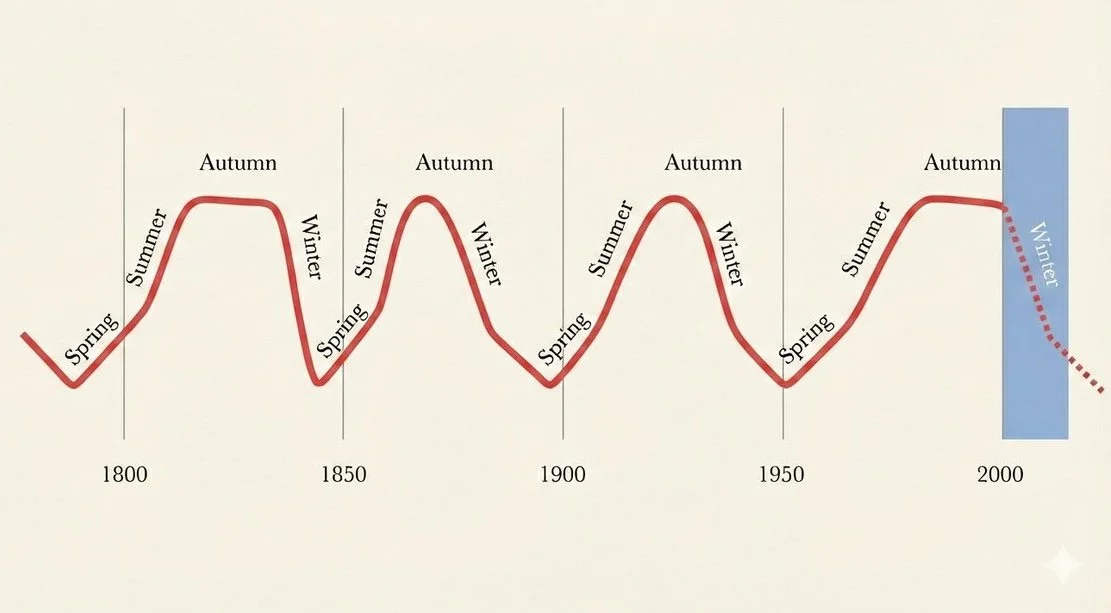
Via looking back at History, both these books state that societies move in arcs roughly the length of a long human life, somewhere around eighty to a hundred years. Why? Because generational experience gradually ages out.
People who have lived through a period of crisis often develop rules designed to prevent it from happening again. Those rules work, stability follows, yet, over time, as new generations grow up and replace the other, the reasons behind those rules fade into the background. Cycles aren’t mystical; they emerge when a generation fades into the next and memory fades.
In The Fourth Turning, Strauss and Howe split this larger ‘human-life’ cycle into 4 different repeating phases: high, awakening, unraveling, and crisis, driven largely by generational turnover.
“Over the course of this book, I hope to persuade you of a more ancient yet also more optimistic doctrine: that our collective social life, as with so many rhythmic systems in nature, requires seasons of sudden change and radical uncertainty in order for us to thrive over time. Or, to paraphrase Blaise Pascal: History has reasons that reason knows nothing of.”
- Neil Howe, The Fourth Turning Is Here
Dalio’s work approaches the same phenomenon from the monetary side, stating that Empires rise through productivity and discipline, then lean increasingly on debt and currency debasement to sustain promises that can’t be politically reversed. Different language, same underlying mechanism.
If these frameworks are correct, the conclusion is uncomfortable: We are no longer early.
We are not at the beginning of a cycle where risks are low, and the path is clear. We are approaching the climax.
According to The Fourth Turning: We are deep into Winter (Crisis). According to Howe, this era began with the Global Financial Crisis in 2008. We have since moved past the “Unraveling” phase (where culture wars feel like sport) into the “Crisis” phase (where they feel existential). This is the season where institutions buckle, and society demands decisive order over individual liberty to solve problems that the old system can no longer handle.
According to The Changing World Order: We are in Stage 5 (The Decline). The classic markers are flashing red: debts are too large to be paid back in hard currency, leading to money printing; internal wealth gaps are fueling populism and polarization; and a rising external power is challenging the existing world order.
We are living through the friction point in the Human Cycle. The “Old World” (post-1945 institutions, debt-based growth, global cooperation) is dying, but the “New World” hasn’t been born yet.
For an investor, this means the strategies that worked during the “Summer” and “Autumn” of the cycle (optimising for stability and cheap credit) are the exact wrong tools for the “Winter.”
Mapping this to markets
Fourth Turnings aren’t just political or social events; they’re monetary events. When debt accumulates beyond what the system can service honestly, governments don’t default in clean, academic ways. They debase, repress, and restructure. The mechanism changes across eras, yet the outcome rarely does.
To gain insight into this, I have looked into the price impact of Gold During these “Crisis Periods” and the following decades after. Most debates about gold fixate on price. However, during regime stress, price is often the least informative signal, with purchasing power telling the real story.
During the early years of the Great Depression (A Crisis Phase), the official price of gold in the United States was fixed at $20.67 per ounce. On paper, it looked boring. In reality, its purchasing power surged.
Between 1929 and 1932, US equities fell by nearly ninety percent. Wages declined sharply. Commodity prices collapsed. An ounce of gold could purchase multiple times the amount of farmland, industrial equipment, and labour it could have just a few years earlier.
Gold didn’t “go up.” Everything else went down.
Gold’s role during deflationary stress isn’t to speculate. It’s to hold purchasing power steady while asset prices reset around it.
The explosive move in gold most people remember, from $35 in 1971 to over $800 by 1980, didn’t occur during the Fourth Turning itself. It arrived after the institutional resolution. Bretton Woods collapsed, convertibility ended, and only then did gold reprice to reflect decades of accumulated monetary expansion. Once the rules changed, the numbers had to catch up.
Across cycles, the pattern repeats:
During a crisis, gold is often controlled or dismissed.
During deflationary stress, purchasing power rises quietly.
During rebuilding phases, suppression masks accumulated pressure.
Once the old regime formally breaks, repricing follows.
The takeaway is clear: Gold protects you from monetary regime change in a crisis.
Infinite leverage in an age of crisis
Fourth Turnings happen because the world changes faster than our ability to manage it. Historically, every major cycle change has been preceded by a massive technological shift that rendered the old social contract obsolete.
The Civil War: The telegraph and railroad collapsed distance, making the fragmented, agrarian governance of the early 1800s incompatible with the new industrial reality.
The Great Depression/WWII: The explosion of mass production and radio in the 1920s created a consumer and financial bubble that the old banking laws couldn’t contain.
In both cases, technology sprinted ahead, breaking the existing institutions. The “Crisis” was the painful period where society scrambled to catch up.
What makes this cycle unique is the specific nature of our new technology. Artificial Intelligence represents a form of infinite leverage. It decouples output from human labor and radically compresses time. You can now write code, generate media, or deploy a fully functioning application in hours rather than months. The activation energy required for innovation has collapsed.
The Paradox
We are left with a massive contradiction. In the digital realm, we have “infinite leverage” - exponential speed and zero marginal cost. But this digital acceleration is colliding headfirst with finite physics.
Data centers need power. And while the code moves at the speed of light, the physical grid moves at the speed permitted by physics.
This is the hard constraint that defines the next decade: You can print money, but you can’t print energy.
In the short term, physics sets the price. This is why unfashionable assets like Energy Infrastructure and Uranium are quietly re-entering the conversation. They represent the bottleneck. If the digital economy wants to grow, it must pay the toll to the physical economy.
The same logic extends to Digital Assets. Just as energy is a physical anchor that cannot be printed, Bitcoin is a mathematical anchor that cannot be debased. It functions as a sovereign-neutral asset in a world where trust in institutions is thinning.
Privacy assets like Zcash take this a step further, reflecting a bet on optionality. As financial systems become more programmable and surveilled, assets that preserve autonomy become valuable at the margin.
These aren’t random, disconnected bets. Energy, Bitcoin, and Privacy are all different expressions of the same trade: Long Reality, Short Fiction. They are the assets that cannot be printed, faked, or diluted by a system trying to inflate its way out of debt.
Concentration first, diffusion later
To understand where we are heading, specifically, how we might shift from the defensive crouch of the late Fourth Turning into the expansive “High” of the coming First Turning, we simply need to look at the distortions in the market right now.
Because the “Physical” constraints (energy, regulation, reality) are difficult to price, capital has fled entirely into the one area where “Digital” leverage feels easiest to capture.
So far in 2025, nearly all of the S&P 500’s gains have been driven by the “Magnificent Seven” - the large technology platforms most directly exposed to the AI infrastructure trade. Strip those names out, and the rest of the index has gone essentially nowhere. Measured against gold, it has actually gone backward.
Right now, markets are rewarding the builders: the compute, the models, and the data centers. This makes sense early in a technological cycle. But as Citrini Research has pointed out, the next phase isn’t about who builds AI. It’s about who uses it to unlock operating leverage.
Most businesses showed little correlation with AI spending in 2025, not because AI won’t matter to them, but because its impact hasn’t yet flowed through income statements, workflow optimisation, automation, and headcount compression take time to show up in reported numbers.
The Rotation
It’s tempting to see the two phenomena described above, the decay of an old institutional order and the rapid rise of machine intelligence, as separate forces. One looks like a breakdown, the other looks like acceleration.
Historically, however, these forces tend to overlap.
Fourth Turnings aren’t only about destruction; they’re about constraint removal. Decades of accumulated debt and increasingly rigid institutions act as a brake on the real economy, absorbing capital, attention, and political flexibility, creating a pile of economic waste just like the Carboniferous Period (yet in that period it was wood, not debt). The “Crisis” is often the mechanism that clears this dead wood (just like the fungi did back then).
@LukeGromen frames inflation and debasement not as policy mistakes, but as the least disruptive way for heavily indebted systems to regain flexibility. When debt levels make austerity or default politically impossible, the system looks for a release valve, and currency debasement becomes that valve.
Ultimately, the most important thing to note is that capital is slowly being forced to discriminate between assets that depend on continuity and credibility, and assets that function despite their erosion.
The Bifurcation
Assets tied closely to the promises of the old system, long-duration sovereign debt, or claims on future cash flows that assume stable policy and low volatility, are behaving very differently from assets that either protect purchasing power or help build new infrastructure.
As someone who is investing in this market, I must ask which assumptions each asset depends on, and whether those assumptions still hold in a world where debasement is increasingly a feature rather than a bug.
The framework I’m operating under
The framework I’m choosing to operate under is simple: we’re likely in the late stages of a Fourth Turning, a period where regime dynamics matter more than optimisation, and where correct positioning matters more than squeezing out the last few basis points of return.
This doesn’t mean I am looking for “safe” or “boring” assets. Being young and active in crypto, I am comfortable with volatility. In fact, I am explicitly looking for it, provided it is the right kind of volatility (you know... number go up).
I am not interested in taking risks on assets that depend on continuity, stable policy, and long-term institutional trust. Those are “status quo” bets, and they have very little upside if the order bends.
Instead, I am taking aggressive risks on discontinuity.
I am biased toward assets that are priced for a world that doesn’t exist just yet. This framework accepts that I might look wrong or early during periods of calm, in exchange for capturing the massive repricing that happens during a transition.
I’m asking what offers the most asymmetric upside if the assumptions underneath the system shift, and that leads me to a barbell allocation focused on two specific themes: Sovereignty and Scarcity.
In total, I’ve distilled this down to five specific asset classes, call them my five rings of power, each offering a unique capability needed to survive the shift.
Theme 1: Sovereignty (The Hedge)
Gold: It anchors purchasing power when confidence in policy and paper promises erodes. Crucially, gold tends to reprice during regime changes rather than standard volatility spikes. It is the insurance policy for the liquidity of the old system.
Bitcoin: A sovereign-neutral asset with no counterparty risk. It is an opt-out from monetary systems rather than a bet on any single one, reflecting the growing demand for portability and credibility in a digital world.
Privacy Assets: Optionality tends to matter most when systems tighten. As financial infrastructure becomes more programmable and surveilled, assets that preserve autonomy (like Zcash) become the ultimate hedge against control.
Theme 2: Scarcity & Modernization (The Growth)
Uranium & Energy Stocks: A recognition of physical constraints. AI, electrification, and re-industrialisation all run into the same bottleneck: energy. You can financialise almost everything, but you still can’t print baseload power.
Ethereum & DeFi: A higher-risk, asymmetric bet on modernization. This rests on the assumption that the US will increasingly use dollar-backed stablecoins as a geopolitical tool, extending dollar reach and exporting debasement. If that path materialises, on-chain infrastructure becomes the downstream beneficiary.
Even if the system muddles through without a crisis, the structural trends remain:
AI still requires massive baseload energy (benefiting Uranium).
The financial system still requires modernization (benefiting Ethereum and stablecoin rails).
Digital value still requires portability (benefiting Bitcoin).
Global central banks still need a neutral reserve asset (benefiting Gold).
A cashless society still requires digital autonomy (benefiting Privacy Assets).
This positioning offers exposure to the growth engines of the next decades, including energy, digitization, and sovereignty, regardless of whether the transition is violent or smooth. I’m comfortable with that trade. What I’m less comfortable with is a framework that only works if nothing fundamental changes. History hasn’t been kind to those assumptions.
Survival first. Prosperity second.